Gemist
Inventory management
Developed an internal platform and increased inventory management efficiency by 70% across a catalogue of 2,000+ products.
Gemist
Inventory management
Developed an internal platform and increased inventory management efficiency by 70% across a catalogue of 2,000+ products.
Gemist
Inventory management
Developed an internal platform and increased inventory management efficiency by 70% across a catalogue of 2,000+ products.


Overview
Context
Gemist, a B2B e-commerce SaaS platform for the jewelry industry, enables brands to offer online jewelry customization with real-time 3D renders. As its e-commerce client base grew, onboarding and inventory management became increasingly complex, stretching timelines to weeks.
Context
Gemist, a B2B e-commerce SaaS platform for the jewelry industry, enables brands to offer online jewelry customization with real-time 3D renders. As its e-commerce client base grew, onboarding and inventory management became increasingly complex, stretching timelines to weeks.
Project overview
The team managed client product data using spreadsheet-based workflows. This manual approach became increasingly tedious and error-prone as the company increasing clients base.
Project overview
The team managed client product data using spreadsheet-based workflows. This manual approach became increasingly tedious and error-prone as the company increasing clients base.
Gathering product options(matrix), creating inventories from scratch, and maintaining data in Excel sheets no longer met the organization's efficiency.
Recognizing these challenges, Gemist want to build a new Content Management System (CMS) that would streamline product data management. I led the design effort for V1 and a subsequent CMS V1.1 release to refine and enhance the tool’s capabilities.
Current experience & key problems
From engaging with stakeholders and users and researching other products, I identified three major problems in user's workflow. The existing spreadsheet-based approach had several critical issues:
Tedious Manual Entry. Entering thousands of rows of product data was time-consuming and mentally draining.
High Error Potential. Mistakes were easily introduced and difficult to track, often requiring multiple checks to verify accuracy.
Limited Visibility on Edits. Changes made by one user could have unforeseen impacts elsewhere, increasing uncertainty and risk.
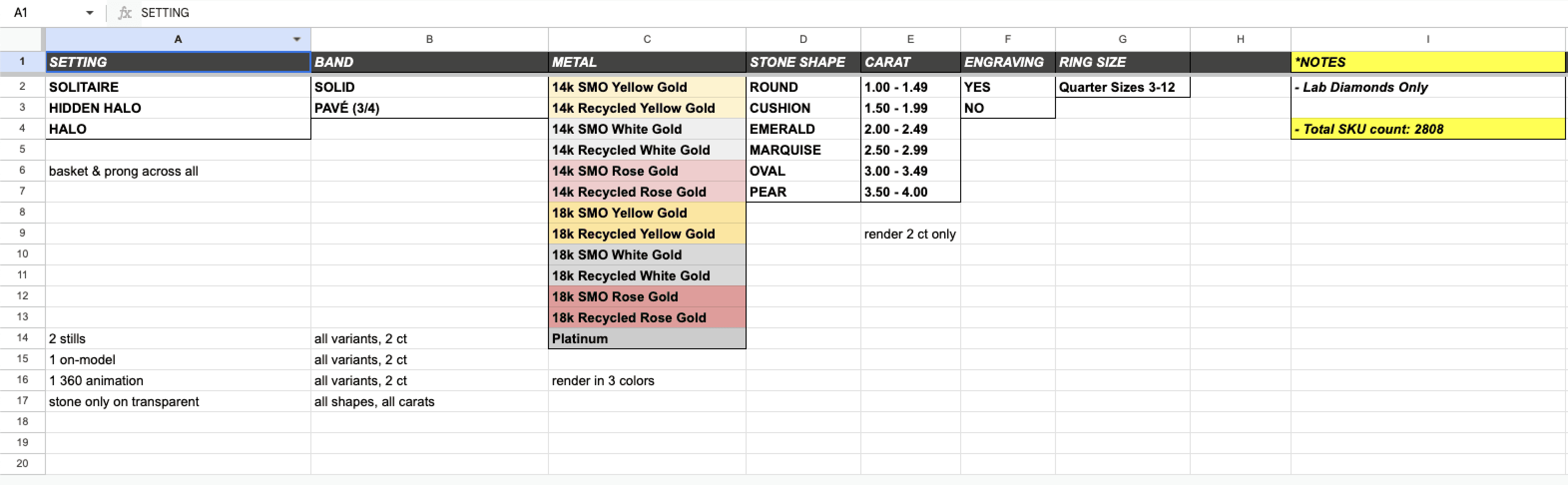
Product option/matrix: Users begin workflow with defining product options/matrix first collabrating with the client.
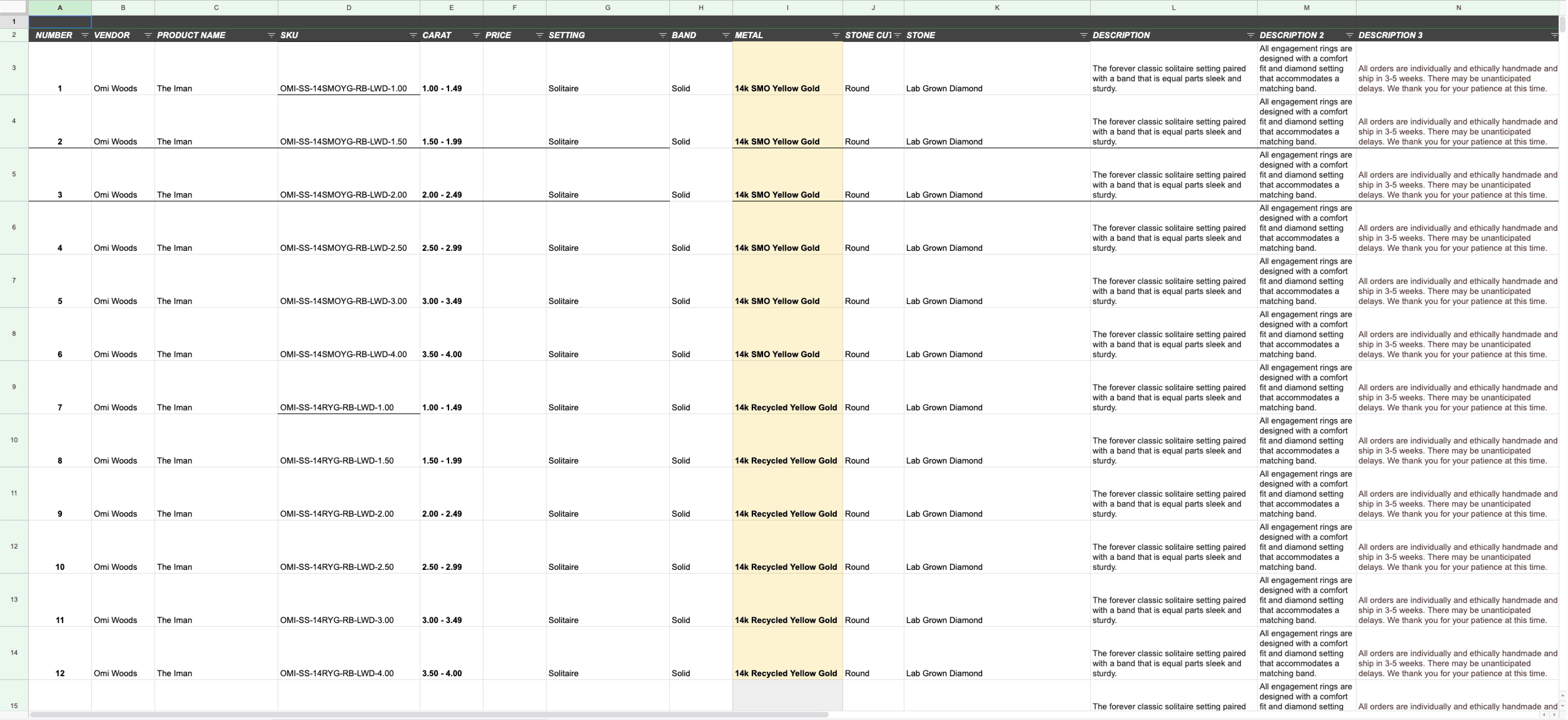
Product option/matrix: Users begin workflow with defining product options/matrix first collabrating with the client.

Users were forced to translate the above product option/matrix into 2800+ rows of products information. This takes weeks of back and fourth engagements with clients.

Users were forced to translate the above product option/matrix into 2800+ rows of products information. This takes weeks of back and fourth engagements with clients.
Issues with other platforms
User research revealed that other platforms, like Shopify and Amazon, could have offered more user-friendly ways to manage large-scale product data. Bulk editing often involved downloading and re-uploading CSV files, mirroring the cumbersome workflows the team sought to replace.
Some advanced bulk editing features existed, they were complex and underutilized.
Goal
Goal
Considering that only about 30% of the jewelry industry operates online, many need to familiarize themselves with advanced digital tools.
Deliver a simpler, more intuitive system that naturally drives CMS adoption—cutting errors, saving time, and elevating data quality.C
Simplify Manual Entry. Make entering and editing product data easier and more efficient than dealing with spreadsheets, steering users toward a better workflow.
Scale Marketing Data Capture. Effortlessly manage thousands of SKUs with a guided interface that streamlines marketing details, ensuring quick edits to messages, subtitles, and titles.
Streamlined Bulk Editing. Enable effortless editing of large product sets while allowing precise individual adjustments as needed.
Result
Result
Predefined options
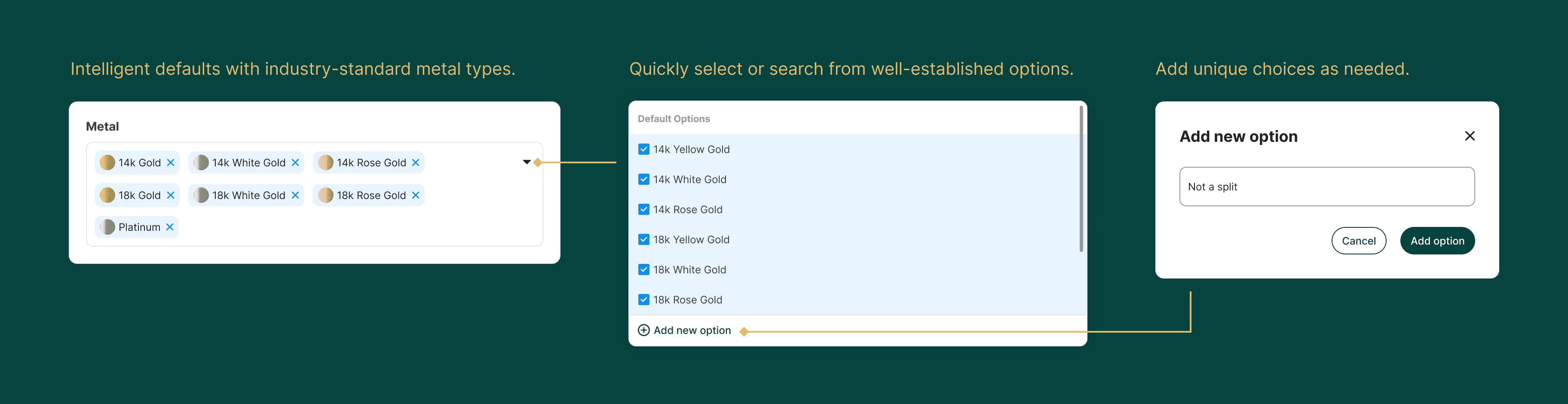
Introduced default predefined options/matrices—from analyzing over 21,000 product entries from 19 clients. Aligned the options/matrices with the jewelry industry’s most common attributes. This shift eliminated cumbersome data entry, reducing initial setup time and inventory generation by 50%.
Predefined options
Introduced default predefined options/matrices—from analyzing over 21,000 product entries from 19 clients. Aligned the options/matrices with the jewelry industry’s most common attributes. This shift eliminated cumbersome data entry, reducing initial setup time and inventory generation by 50%.

It’s simpler to tweak than to build product options/matrix from scratch.

It’s simpler to tweak than to build product options/matrix from scratch.
Automated product sheets to save hours
With just a few clicks, users could instantly generate detailed product sheets directly from their matrix sets, saving significant time and simplifying workflows.
Automated product sheets to save hours
With just a few clicks, users could instantly generate detailed product sheets directly from their matrix sets, saving significant time and simplifying workflows.
Automated product sheets to save hours
With just a few clicks, users could instantly generate detailed product sheets directly from their matrix sets, saving significant time and simplifying workflows.
Streamlined bulk editing process
By alerting users to enter marketing data and presenting these fields in a bulk editing turned into a streamlined process. This approach improved data accuracy by 30%, freeing marketing teams to invest more energy in strategic, narrative-driven tasks rather than struggling with complex spreadsheets.
Streamlined bulk editing process
By alerting users to enter marketing data and presenting these fields in a bulk editing turned into a streamlined process. This approach improved data accuracy by 30%, freeing marketing teams to invest more energy in strategic, narrative-driven tasks rather than struggling with complex spreadsheets.
Streamlined bulk editing process
By alerting users to enter marketing data and presenting these fields in a bulk editing turned into a streamlined process. This approach improved data accuracy by 30%, freeing marketing teams to invest more energy in strategic, narrative-driven tasks rather than struggling with complex spreadsheets.
Smarter editing process with instant feedback
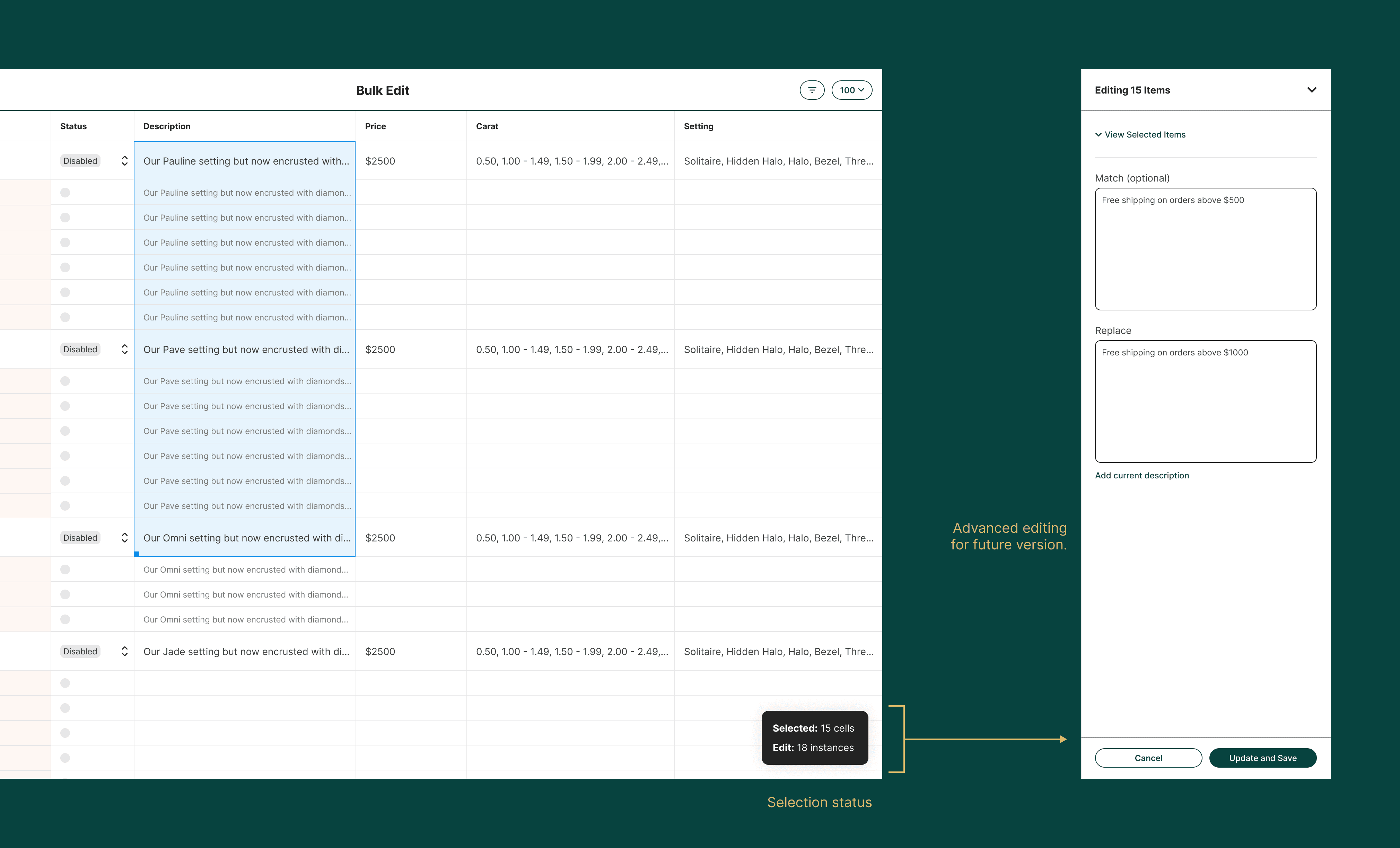
Real-time informational messages highlighted selected attributes, active editing cells, and the total number of resulting product variations. This feedback loop decreased errors by 40%, boosted user confidence, and established a strong foundation for future enhancements—such as integrating a rules engine for even more guided and intelligent edits.
Smarter editing process with instant feedback
Real-time informational messages highlighted selected attributes, active editing cells, and the total number of resulting product variations. This feedback loop decreased errors by 40%, boosted user confidence, and established a strong foundation for future enhancements—such as integrating a rules engine for even more guided and intelligent edits.

Smarter editing process with instant feedback
Real-time informational messages highlighted selected attributes, active editing cells, and the total number of resulting product variations. This feedback loop decreased errors by 40%, boosted user confidence, and established a strong foundation for future enhancements—such as integrating a rules engine for even more guided and intelligent edits.

Positive results and more to do
The CMS dramatically streamlined product management, enabling rapid matrix generation, easy marketing content edits, and seamless CSV exports to other systems.
This optimization achieved a 70% increase in inventory management efficiency and saved weeks work for a catalogue of over 2,000 products, significantly reducing errors in the process.
Looking ahead, a beta version currently in testing is already demonstrating the platform’s evolving potential. For example, an integrated pricing engine dynamically adjusts product prices based on customizable rules. As these new features mature—among them a comprehensive product rule engine—the platform is poised to deliver even greater operational value and scalability.
